Eternal Currents
But the living all make the same mistake: they distinguish too sharply.
Angels (it’s said) often don’t know whether they’re moving among
the living or the dead. The eternal current
sweeps all the ages with it through both kingdoms
forever and drowns their voices in both.
~ Rainer Maria Rilke, Elegy I, Duino Elegies1
Over the course of a desolate winter during which I’d been ghosted, I found myself bingeing testimonies of near-death experiences (NDE) online. This may sound dramatic, morbid even. However, the recurring message that emerged across these uncannily similar accounts, despite the vast range of the subjects’ backgrounds (from staunchly atheist neurosurgeons to preacher’s wives), was anything but.
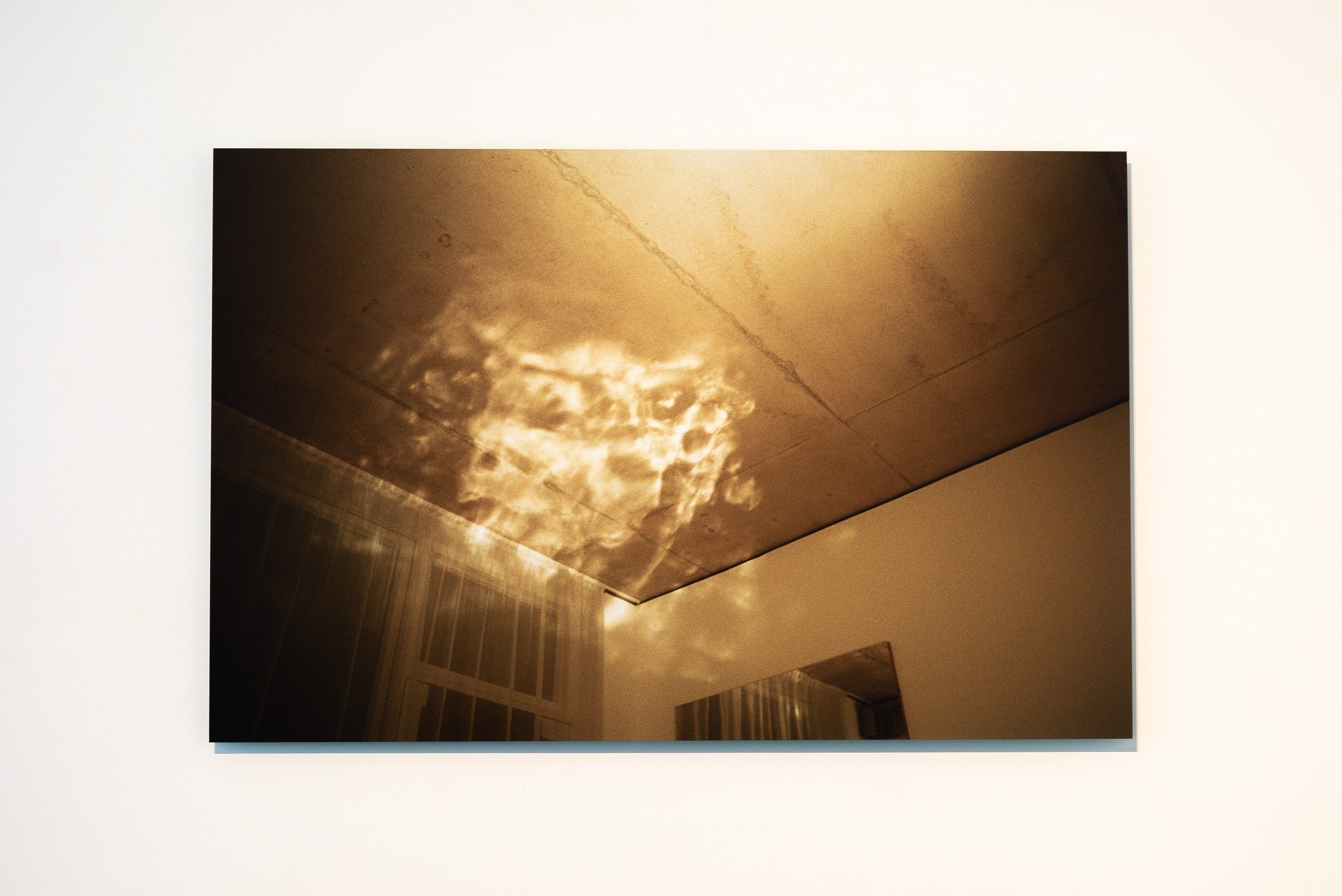
“I felt like I was this pure essence, so wide, so present.” This is how Pure Joy (2026), a newly commissioned multimedia installation2 by British artist Leah Clements for the exhibition “Flare-Up” at Goldsmiths CCA, begins. Set to oscillating vocalizations of a chorus, the piece relays artist Renu Aurora’s NDE after being hit by a bus. Suspended above the listeners’ heads, a transparent tarp filled with water is intermittently spotlit at moments when the audio swells, sending caustic reflections rippling across the gallery floor. Water is something of a signature across Clements’ practice, which through film, photography, sound, installation, and text, explores the various psychological and somatic experiences induced by illness; the hallucinatory and time-bending shifts in perception during moments of incapacitation, those glimmering states where the veil between this physical world and some other plane of consciousness grows thin. The material fluidity of water, the oceanic feeling3, courses through the work, pointing us to a hinterland of reality, potential sites beyond the physical for crip collectivity and indeed, joy.
Aurora describes her NDE as “being surrounded by beautiful shards of light…beaming into me from every direction like a star. And the light was giving me love…like I was being filled up to the brim with love. I felt like I was everyone, everything, expanded, expansive. And then I heard a voice from the right hand side…and the voice said: love is all there is.”4
Quite a far cry from the collective cultural fashioning of spectrality, wherein the phantom is by and large associated with the dominant affects of fear, grief, depression. A hauntology steeped in the hair-raising disorientation begat by the “failure of absence or presence,” as Mark Fisher so perfectly defined the weird and the eerie.5 Nothing where there should be something, or something where there should be nothing. Ghost stories are the horror genre’s paradigmatic narrative: melancholic and chilling. And yet, as in NDEs and reports of people who’ve had contact—either spontaneously or via mediums—with those who have passed, encounters with this other realm are repeatedly relayed in terms of an ineffable sense of awe, beauty, and connection.
In contemporary discourse, however, we tend to conceive of the ghost as the trace, the archive, the presence of an absence, pointing, always, to what is not (yet or anymore) here. Jacques Derrida theorized the spectral in terms of a temporal glitch or disjuncture—”the time is out of joint,” as he quotes from Hamlet—acknowledging the spookiness of time while still positioning it as a deviation from a linear framework of separate temporalities: past, present, future.6 Likewise, in common parlance, the “beyond” is often situated somewhere above us, a notion reinforced by the language we use—paranormal, supernatural—to describe that which we cannot see or explain. I’m reminded of a talk with the psychic medium Laura Lynn Jackson at the now closed Rubin Museum7 in New York City, part of a symposium on consciousness and time. When asked where exactly the “other side” is, Jackson described the physical and metaphysical realms like two sides of a translucent sheet, or holographic card. “It’s right here. It’s right now. It’s right with us.”8
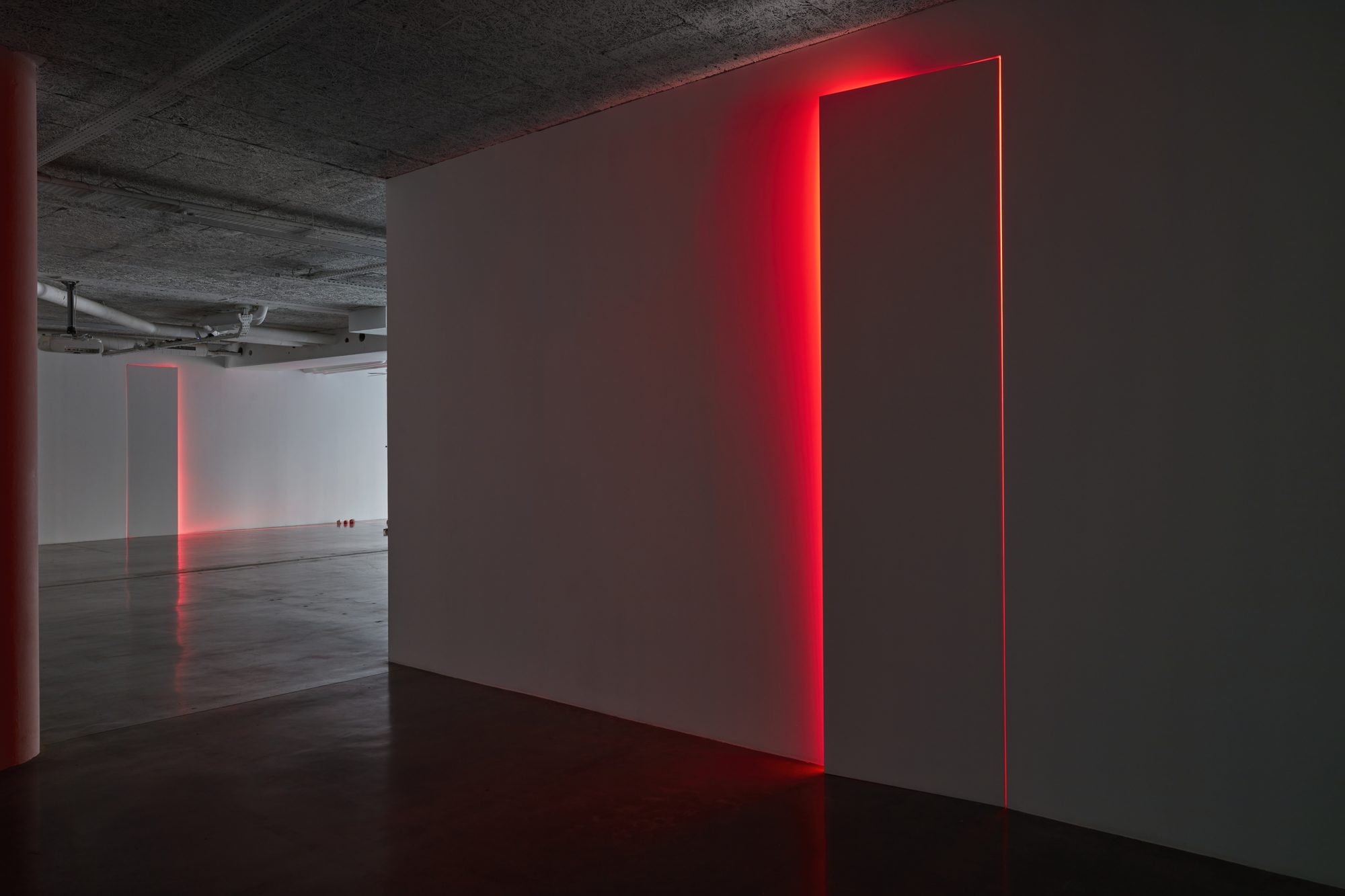
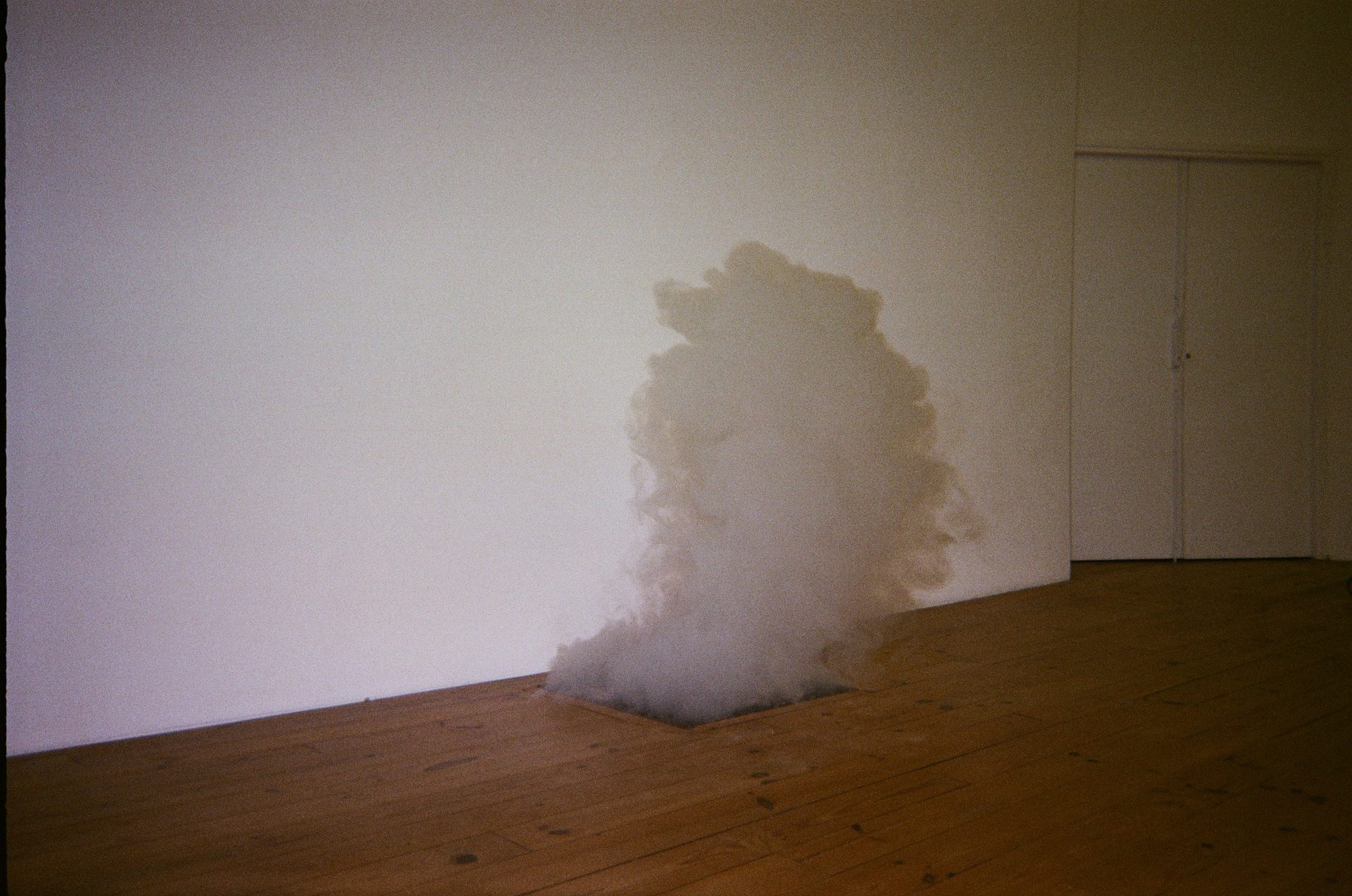
Camille Brée’s installations seek to materialize this gossamer threshold, using intangible and refractive media such as artificial light, smoke, and glass, to harness and nudge our perception towards the energies inherent in a given room. Attention is coaxed toward the literal and metaphysical seams of the gallery’s architecture—a shaft of red light emanating from a slit in a wall, smoke billowing at random intervals from a hidden grate in the floor—playing on subtle, collective alert signals. In a series of light sculptures, as in Light Bulbs Conversation (2019) or Poignée de porte béquille (2022), drooping resin-cast bulbs appear to be melting, at times even enveloping existing objects like ectoplasm. Their translucent forms playfully imagine how such phenomena might appear in a higher dimensional reality: voluminous and viscous.
Some weeks ago, I was on a site visit with Brée to a supposed haunted house in Paris’ 9th arrondissement. As we ambled from one dark panelled room to another, the atmosphere grew denser and Brée had to sit down. It had become difficult for her to breathe. She divulged her own mediumistic abilities, which manifest as clairvoyance, clairaudience, and clairsentience—the presence of vibrational frequencies appearing to her as shadows, luminous threads of light, vivid images, sounds, and bodily sensations. Curiously, the connection between Brée’s extra sensory perception and her material interests as an artist had largely eluded her until last year when, on an artist’s residency in London, she encountered the Arthur Findlay College of Psychic Studies and applied her production budget towards tuition.
Brée had been invited to London to research the city’s historic gas lamp infrastructure. She was intrigued by the boundary between obscurity and illumination thrown into relief by this public utility, and the material yet hidden network of power supplying the city with light, which she saw as parallel to the invisible energetic networks linking living beings. In the Rubin Museum conference, Jackson explains the interconnectedness between souls as shown to her by her spirit guides via the image of a maypole. “Your soul, or light energy, is part of the greater light energy, but it divides out into these strings of different lifetimes where you’re playing a role, but it’s all tied on the other side and it’s all happening at the same exact time.”9 When questioned about the place of art and creativity, Jackson answered, “when we bring art into our energy, it’s like turning brightness up on our connections to each other and the universe…When we experience art, we connect with this grand grid of light.”10
As a sculptural material, light symbolizes this spectral bridge and all that is suspended in-between, recalling a principle in quantum physics known as superposition, which posits that particles exist in all possible states (e.g. wave or particle) until they are observed or measured, at which point they become one or the other. It’s suggested that this moment of collapse is consciousness.11 As the science journalist and author Lynne McTaggart writes in The Field, “When we bring energy to conscious awareness through the act of perception, we create separate objects that exist in space through a measured continuum. By creating time and space, we create our own separateness.”12 But we are not separate, as quantum physics has also proved through a phenomenon known as entanglement, in which two or more particles become inextricably linked. When this happens, the physical state of one particle instantly dictates the state of the other, regardless of physical distance, an event called ‘non-locality’. Einstein famously referred to this discovery, so troubling to classical physicists, as “spooky action at a distance.”
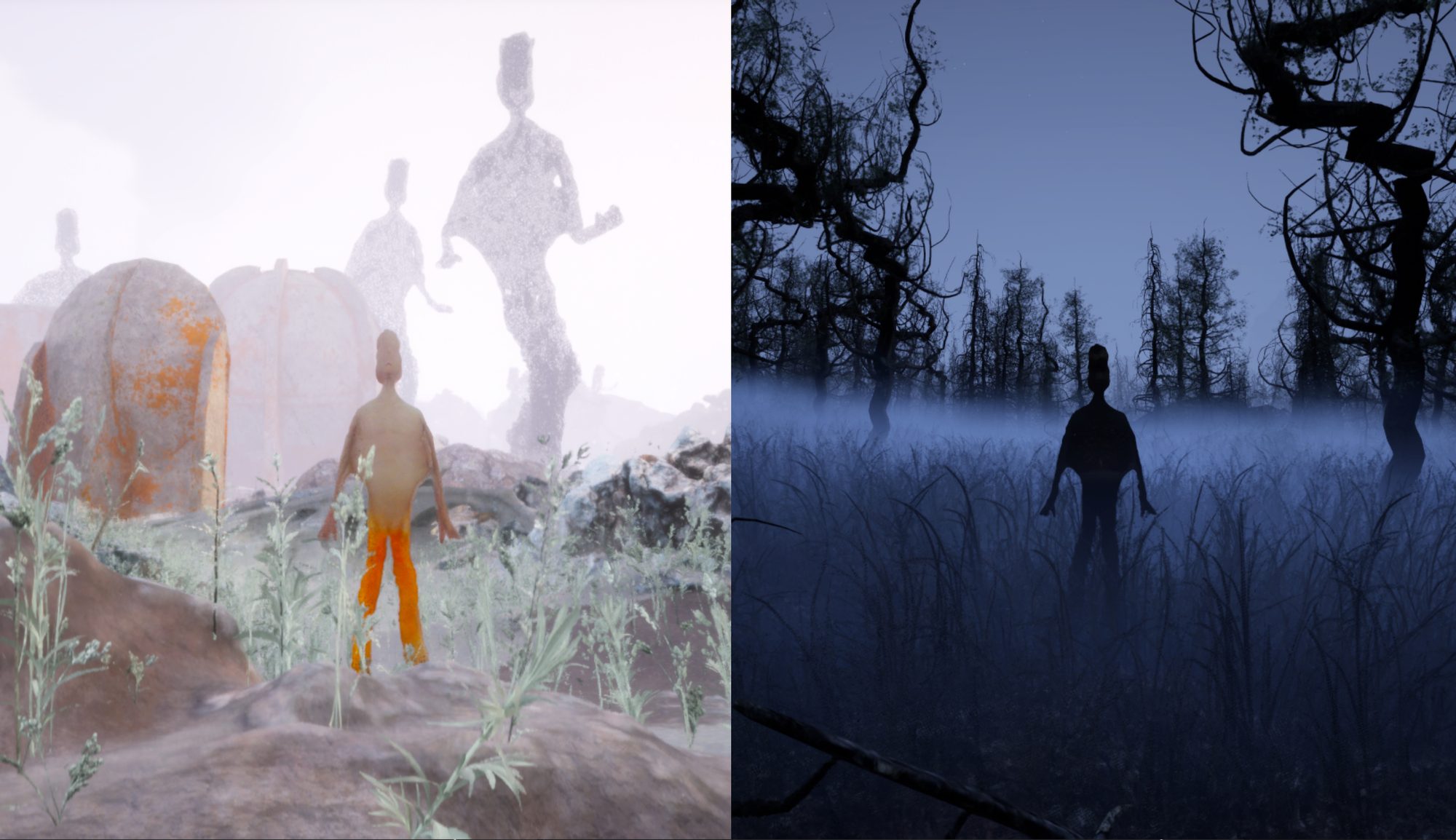
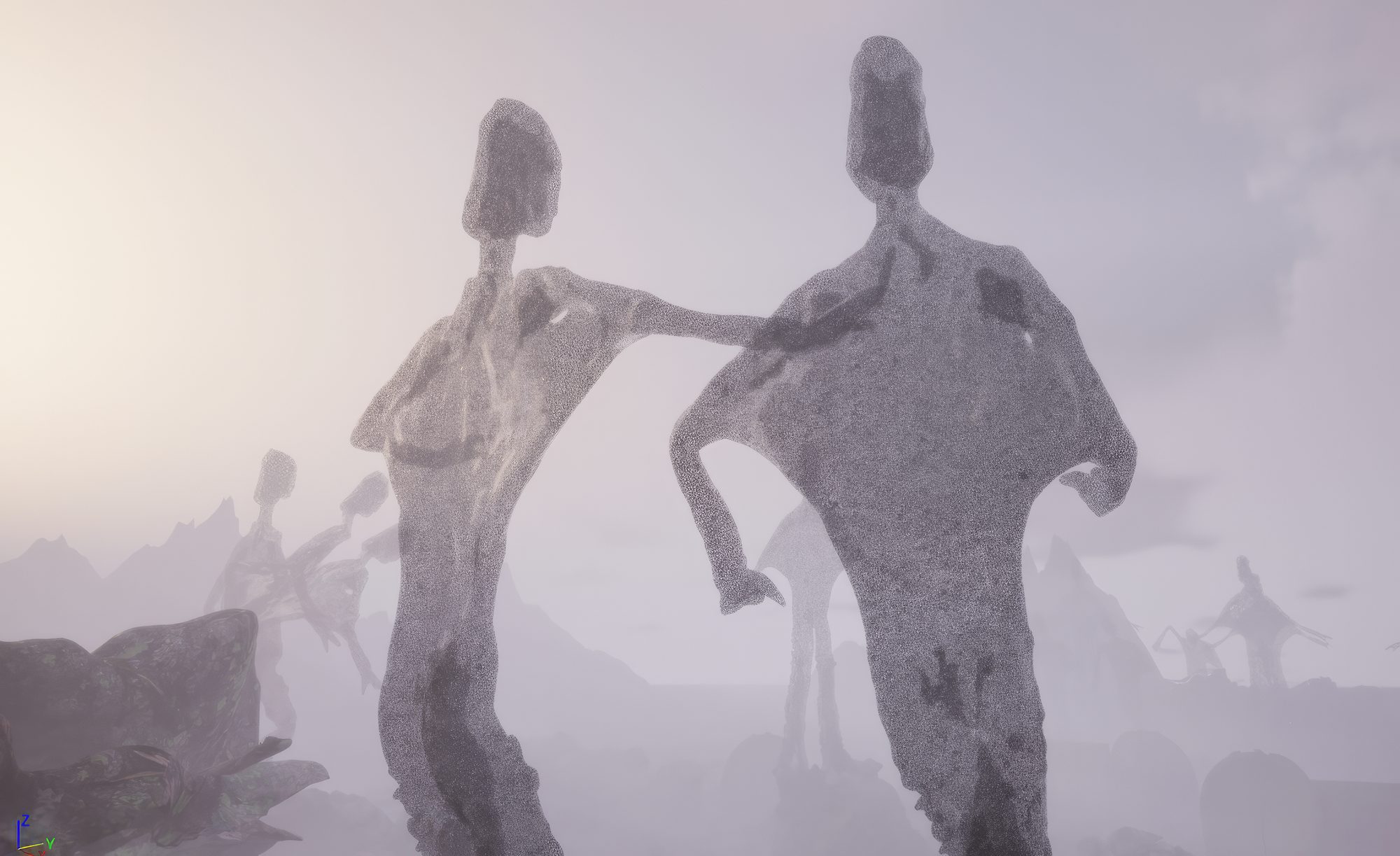
In Alice Bucknell’s Small Void (2025)13, a two-player video game produced in collaboration with theoretical physicists at CERN, the instantaneous, invisible impact of one particle on another is reconceived as a queer dating simulation about “the frictions and expansions of identity that love induces.”14 The work unfolds across two large screens facing each other so that the players sit back to back. One world depicts a moonlit forest, the other a lunar desert. Both landscapes are modeled on lichen, the binary-blasting organisms that are at once singular and multiple entities, microscopic and capable of covering vast swathes of terrain, capable of dying and coming back to life. The avatars, roughly rendered as shadowy humanoids in platform boots, are entangled particles of matter and antimatter, whose aim is to find each other and, in doing so, cause their mutual, rapturous, annihilation. As each particle runs and jumps through their respective worlds, the opposite player can sense the proximity of the other’s presence through vibrations in the controller.
If we can theoretically accept that everything is everywhere all at once, it follows that our physical body, the mortal coil around which subjective consciousness is wrapped, creates and limits our perception of a far stranger reality. But there’s the rub. While embodiment temporarily severs us from the primordial quantum soup, or informational substrate of energy, it’s also the only interface for it that we’ve got. My hands continued vibrating long after I set the controller to Bucknell’s game down, the tremulous feeling moving up my arms, into my throat, my chest echoing every moment of grieving and yearning I’ve ever felt, of a deep inexplicable tugging towards those whom a rationalist world view would tell me are no longer or not yet here.
By no means exhaustive, these works propose an aesthetics of spectrality rooted in the production of physical conditions and sensations that invite the viewer to become aware of being in relation, in co-creation, with a reality not fully perceptible or locatable but so much more awesome than we can humanly apprehend. Being haunted can affirm our inseparability from all things, from the energetic ties that bind, and give form, however fleetingly, to that eternal (hydraulic, electrical, quantum) currents Rilke wrote of that sweeps all the ages through it, forever.
- Rilke, Rainer Maria. “The First Elegy.” The Poetry of Rilke: Bilingual Edition, translated and edited by Edward Snow, North Point Press, 2009. Poetry Society of America, poetrysociety.org/poems/the-first-elegy. Accessed 19 May 2026.
↩︎ - The installation is composed of a sound piece accompanied by a projection of its subtitle and a sign language interpreter beneath a tarp full of water.
↩︎ - Coined by French art critic and mystic Romain Rolland in a 1927 letter to Freud to describe the “feeling of the eternal (which can very well not be eternal, but simply without perceptible limits).” Rolland, Romain. Letter to Sigmund Freud. 5 Dec. 1927. Sigmund Freud et Romain Rolland: Correspondance 1923-1936, edited by Henri Vermorel and Madeleine Vermorel, Presses Universitaires de France, 1993.
↩︎ - Leah Clements, Pure Joy (2026). Flare-Up, curated by Mariana Lemos and Natasha Hoare. 21 May – 16 August 2026,CCA Goldsmiths, London.
↩︎ - Mark Fisher, The Weird and the Eerie, London, Repeater Books, 2016. p.40.
↩︎ - Derrida, Jacques, “The Time is Out of Joint”, Deconstruction is/in America: A New Sense of the Political, ed. Anselm Haverkamp (New York: NYU Press,1995), 14-15.
↩︎ - “Psychic Medium Laura Lynne Jackson + Dr. Mark Epstein.” YouTube, uploaded by Rubin Museum of Art, 23 Feb. 2018, www.youtube.com/watch?v=I7oJ67l_N_Q.
↩︎ - Idem.
↩︎ - Idem.
↩︎ - Idem.
↩︎ - “Why Consciousness Must Be Quantum Mechanical | Stuart Hameroff | Full Interview.” YouTube, uploaded by The Institute of Art and Ideas, 6 Mar. 2025, www.youtube.com/watch?v=lGOagUj-fYM.
↩︎ - Lynne McTaggart, The Field: The Quest for the Secret Force of the Universe, 2001. p. 224.
↩︎ - Developed through the Collide residency program between Arts at CERN and Copenhagen Contemporary, in collaboration with Jonathan Coryn, scored by Madga Drozd, features a custom typeface by Daytona Mess, and was produced with the support of Vincent Moulinet.
↩︎ - Alice Bucknell, “Small Void,” Arts at CERN, accessed 21 May 2026. https://arts.cern/commission/small-void/.
↩︎